
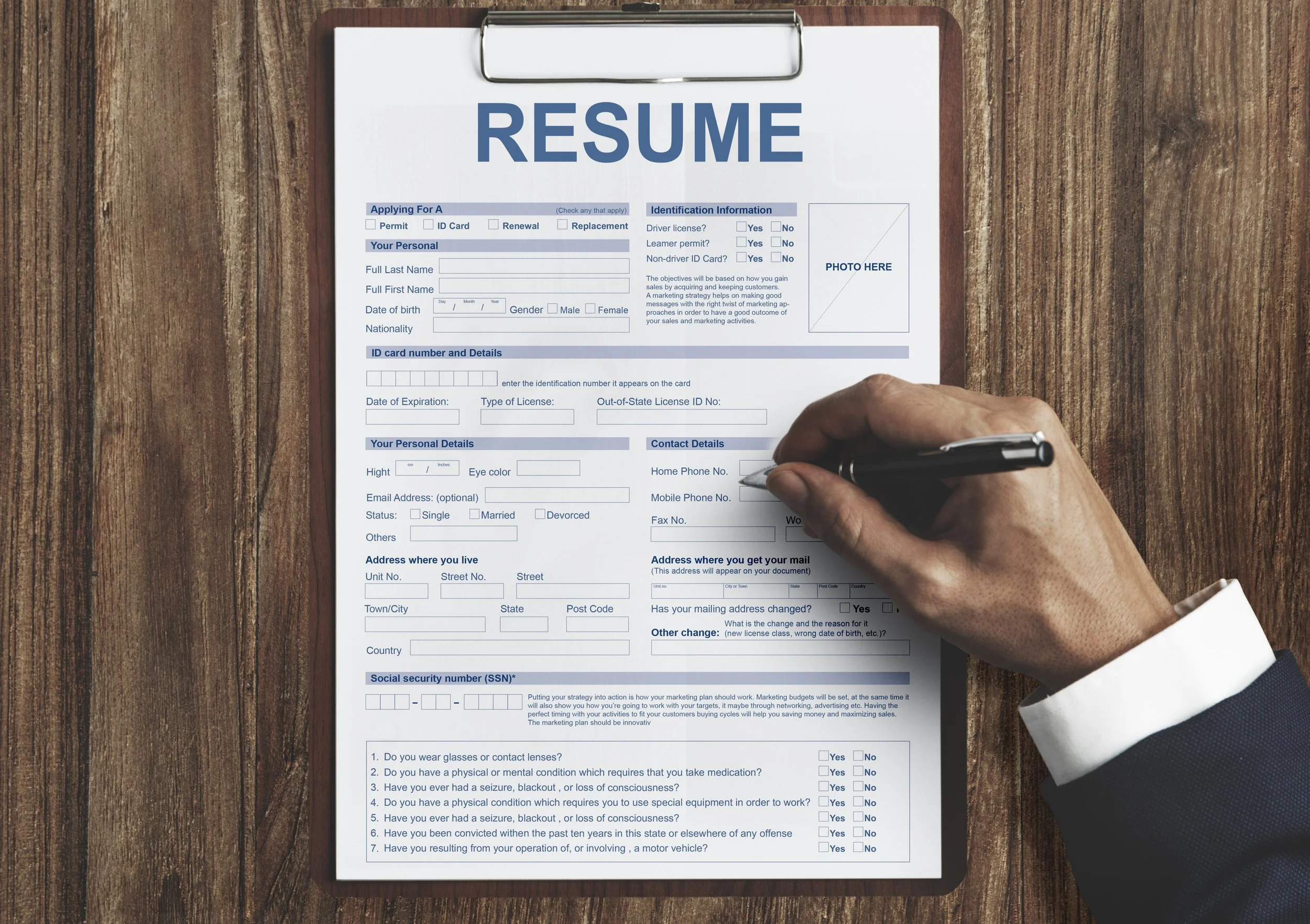
The Resume Glow-Up: 4 Updates That Help You Stand Out
Before I stepped into HR, I did exactly what most people do when they're in job search mode…I went into full reactive mode. A job description would come up, and I would copy and paste every bullet point of what I did into my resume and hit send. I genuinely believed that was the right approach. I thought showing everything I had touched in a role would impress a hiring manager.
It wasn't until I sat on the other side of the table, in the HR seat, actually reviewing resumes that everything became clear. And once I understood what employers were really looking for, I realized most job seekers are missing it entirely.
Because here is what nobody tells you when you are out there applying: hiring managers and recruiters are not reading your resume the way you wrote it.
What the HR Seat Taught Me
When I transitioned into HR, I quickly recognized that there are essentially two levels of evaluation happening before a candidate ever walks through the door for an interview.
The recruiter's primary objective is to assess competency. Can this person actually do the job? They are scanning resumes and I do mean scanning, because their time is limited, looking for signals that a candidate has the foundation to perform in the role.
The hiring manager goes deeper. They want to know: Have you done this before? What did you actually accomplish? How much investment will training require? Are you the right fit not just in personality, but in demonstrated impact?
The challenge is that most resumes are written to answer neither of those questions effectively. They read like a job description. And a job description is not a resume. It outlines what a role requires not what you delivered.
That is the gap. And that is exactly what the Resume Glow-Up is designed to close.
1. Replace Job Duties with Results
Most resumes tell employers what you did. The best resumes show the impact you made.
There is a significant difference between writing "Managed employee onboarding" and writing "Redesigned the onboarding process, reducing new hire paperwork delays and improving first-day readiness."
One describes a responsibility. The other demonstrates professional value.
When reviewing resumes in my HR capacity, I am not moved by a list of duties. I already understand what the role entails; that is why we posted it. What I need to know is: What did you do with the opportunity? What did you implement, complete, improve, or transform while you were there?
Stop writing your resume like a job description and start writing it like a performance review, one where you are giving yourself every bit of credit you have earned.
2. Tailor Your Resume to the Job
This step sounds straightforward, yet it remains one of the most overlooked elements I see in resume reviews.
Every job posting is communicating something. The language used, the skills highlighted, the qualifications listed that is a roadmap. Your resume should speak that same language back to the employer.
If a company is seeking someone with experience in employee relations and your resume buries that under a vague bullet point about "supporting staff", you have already lost their attention. Recruiters are scanning. If what they need is not immediately visible, they are moving on.
Align your resume to the role. Draw the key skills and language directly from the job description and ensure your experience reflects those same priorities. If the job requires a specific skill set, it should be easy to locate on your resume not something a recruiter has to search for.
3. Cut the Clutter
Recruiters spend only a short amount of time scanning resumes. That means every single element on your resume needs to earn its place.
The objective statement at the top? Remove it. Long paragraphs describing your experience? Streamline them. Skills that have not been relevant in years? Take them out. Graphics and design elements that applicant tracking systems cannot read? Eliminate them.
What you want is a resume that is clean, scannable, and strategic. Recruiters do not have the bandwidth to read through an essay and they should not have to. If your most relevant experience is not standing out within the first few seconds of review, it is not working hard enough for you.
In this case, less is truly more when it is the right less.
4. Quantify Your Impact
This is the area I emphasize most consistently, because this is where real transformation happens.
Numbers build credibility. Metrics tell your professional story far more effectively than adjectives ever will. There is a measurable difference between "Improved project efficiency" and "Delivered 12 cross-functional projects on time and under budget, improving stakeholder satisfaction by 22%."
One is a statement. The other is proof.
Hiring managers are significantly more likely to advance a resume that contains quantified metrics because it gives them something concrete to reference. In the interview, they can speak to it directly. They can ask informed questions about it. They can justify the hire based on documented results. You are not simply telling them you are capable, you are showing them the evidence.
I have worked with clients who came to me with resumes containing two or three vague bullet points per role that communicated very little. The experience was there, it simply was not being presented in a way that reflected it.
Once we worked together to unpack what they actually accomplished and the real impact they had made adding depth, adding metrics, adding the proof then everything shifted.
---
## A Real Story: From $60K to $130K
I want to share a client experience because I do not simply talk about this framework — I have watched it work.
I worked with a professional in the construction industry who had been actively applying for positions for an entire year. Twelve months of applications, limited callbacks, and a compensation level that did not reflect the expertise they had spent years developing.
They were not looking to change careers. They wanted to level up and move into a new company, step into a more senior role, and finally be compensated in alignment with the value they consistently delivered.
When we first connected, their resume was minimal. A few general bullets per role, no metrics, nothing that communicated the depth of what they had actually accomplished. It reflected their duties. It did not reflect their impact.
We worked together to reframe the entire document. We identified their key accomplishments. We attached outcomes and numbers to their experience. We tailored the language to speak directly to the operations management roles they were targeting.
The result? They secured an Operations Manager position that moved their compensation from $60,000 annually to $125,000. And because their resume had positioned them with clear, documented proof of value, they entered salary negotiations with confidence and walked away with an additional $5,000 above the initial offer.
That is the transformation. And it was not by chance. It was by strategy.
The Truth About Using AI for Your Resume
There is an important conversation happening right now around artificial intelligence and resume writing and I want to address it directly.
Professionals are using ChatGPT, Claude, and other AI tools to generate their resumes. I am not here to tell you not to leverage those tools. What I am here to tell you is this:
Do not let AI write your resume. Let AI work for your resume.
There is a meaningful distinction. Submitting a job description to an AI tool and asking it to generate a resume will produce something generic, something that lacks your actual voice, your specific metrics, and the nuance of your real professional impact. It will read like everyone else's resume because it was built from the same general framework.
But if you approach AI with intention, if you say "Here is the job description, here are my actual accomplishments and quantified outcomes, help me communicate this in a way that speaks directly to this role" — now you are using it as a strategic tool rather than a replacement for your own expertise.
The goal is a resume so targeted and so rich with evidence of your contributions that a recruiter is compelled to place it in front of the hiring manager. That is the standard.
What Comes Next
If you have read this and recognized yourself in any part of it, that is not a setback. Most professionals were never formally taught how to write a resume that performs. We figured it out as we went, and for many people, that means defaulting to job descriptions and hoping the right person notices.
But now you have a different framework. And with the right approach, your resume can become one of the most powerful tools in your career strategy.
Work through these four updates. Make the changes. Then see what happens.
If your resume still is not generating the traction it deserves , if you want a professional review, a tailored strategy, and expert guidance built around your specific experience and goals, I would love to connect with you.
Book your free discovery call at elevarecp.com.
Because this is what I know with confidence: when you lead with your impact, tailor your approach, present a clean and strategic document, and back it all with real numbers, you will be positioned to earn what you are worth in your next role.
That is not a claim. That is a pattern I have watched repeat itself, time and again.
And it can be your story too.

Workday Rejected You But Its AI May Have Influenced That
Let’s be honest. When AI first showed up in the HR space, a lot of us were skeptical. New technology, unknown outcomes, and a whole lot of “we’ll see.” But it proved itself. The efficiency, the scale, the ability to process thousands of applications in seconds it delivered. And now? Everybody’s using it. Recruiting, screening, scoring candidates..AI is embedded in how we hire.
But here’s where it gets interesting.
Now that it’s proven and widely adopted, I’m noticing that we’ve stopped watching it as closely as we should. We trust the output. We move on. And that’s exactly what I explored in my first article on The Pulse — [Are You Actually Reading What AI Is Telling You?] The Workday lawsuit brings that question to life in a very real way.
What’s Actually Happening in This Case
Mobley v. Workday, Inc. is a federal lawsuit filed in California alleging that Workday’s AI-powered hiring tools discriminated against job applicants based on race, age, and disability. The lead plaintiff, Derek Mobley, a Black man over 40 who also lives with a disability applied to more than 100 positions through companies using Workday’s platform and was rejected every single time.
What made the court take notice wasn’t just the volume of rejections. It was the timing. Rejection emails were coming back outside of business hours, within minutes or an hour of applications being submitted. Nobody is sitting at a desk at that hour making thoughtful hiring decisions. That was automated. That was the machine.
The plaintiff in the case is a cancer survivor with an asthma diagnosis. The court noted that employment gaps, the kind that often show up when someone has dealt with a serious health issue that may have been used as proxy indicators by the algorithm. Not intentional discrimination. But discriminatory outcomes nonetheless.
The judge refused to dismiss the case. That matters.
AI Didn’t Make the Hiring Decision But It May Have Influenced It.
That’s the distinction that keeps coming up for me professionally, and it’s the one that makes this case so significant. Workday’s position is that their AI didn’t make the final hiring decisions and technically, that may be true. The employer still clicked the button. But when an AI system is screening, scoring, and narrowing the candidate pool before a human ever looks at a résumé, the decision has already been shaped. The slate has already been filtered. And if bias exists somewhere inside that system whether it was built in intentionally or not, a human approving the shortlist doesn’t undo it.
This isn’t about pointing fingers at Workday specifically. I don’t know what those contracts and backend systems look like, and it’s not my place to say who’s right or wrong. But what this case is surfacing is a conversation that the HR profession needed to have a long time ago.
The Real Question for Employers
Are you actually paying attention to what your AI tools are doing inside your hiring process? Not what the sales deck said. Not what the implementation team told you during onboarding. What is it actually doing, how was it built, what was it trained on, and what patterns is it looking for when it scores your candidates?
Because here’s what a lot of employers don’t fully realize: third-party tools don’t absorb your liability. They extend it. Workday is being sued. But the companies using those tools are next in line. Courts are beginning to establish that employers are responsible for understanding and overseeing the technology they deploy in their hiring process regardless of whether a vendor built it.
What You Can Do Right Now
This isn’t about abandoning AI. I use it. I believe in it as a tool when it’s used with intention and oversight. But “intention” means knowing what you signed up for.
Here are a few places to start:
Ask your vendors harder questions. How was this system trained? Has it been tested for disparate impact? What does the audit trail look like when a candidate is flagged or ejected?
Review your outputs. Pull your data. Are certain demographics consistently being screened out at the top of your funnel? If you can’t answer that question, that’s a gap worth closing.
Don’t outsource your accountability. AI can handle volume. But HR still has to own the process. Build in human checkpoints, especially at the screening stage.
Read your contracts. Understand what your vendor is and isn’t responsible for when things go sideways.
The Bottom Line
The Workday case is still unfolding. But the conversation it’s forcing is one every HR leader and employer needs to be in right now. AI has proven its value. That’s not the debate. The debate is whether we’re being intentional enough about how we use it and whether we’re actually watching what it’s doing on our behalf.
If you don’t have those answers yet, that’s exactly where the work starts.
Want to talk through what this means for your organization? Let’s connect.
And if you missed the first article that started this conversation Are You Actually Reading What AI Is Telling You?— start there.

Are You Actually Reading What AI Is Telling You?
Are You Actually Reading What AI Is Telling You?
A perspective from Schilla Toussaint, Founder & President of Elevare Consulting Partners
There’s a Forbes article making its rounds that stopped me in my tracks and as an HR strategist, I couldn’t scroll past it without saying something.
The research is pointing to something we already feel but haven’t said out loud: we’ve stopped questioning AI.
For low-stakes tasks? We copy, paste, and move on. But the moment the stakes get high, suddenly we’re reading every word. That inconsistency is a problem because AI doesn’t know the difference between low and high stakes. We do.
Here’s what hit me hardest: the concept of shifting from task execution to task stewardship. We were hired to DO the work. Now we’re being repositioned to OVERSEE what AI does. That sounds like a promotion, but for a lot of workers, it’s actually a quiet elimination.
Companies are automating the task AND hiring someone new to watch the automation. The person who used to do the job? Gone.
My hot take as an HR professional:
Learn AI. Get certified. Become the subject matter expert in your lane because that is where the job market is moving and it is moving fast.
The workers who thrive won’t be the ones AI replaces. They’ll be the ones who learned to lead it.
Read the full article here: https://www.forbes.com/sites/charlestowersclark/2025/03/14/how-ai-changes-critical-thinking-new-microsoft-research-findings/